When purchasing protective gear, most people assume they have two choices: buy the cheaper option and accept less protection, or spend more and receive something safer.
Unfortunately, it is not that simple.
Some expensive protective equipment performs exceptionally well. Other expensive products are uncomfortable, poorly fitted and supported by little or no meaningful impact-performance data. At the same time, some lower-priced products may provide adequate protection for their intended use.
The real question is not:
“Is expensive protective gear worth the money?”
It is:
“What measurable protection, comfort, durability and performance am I receiving for my money?”
A High Price Does Not Guarantee High Protection
I learned this lesson through personal experience.
Years ago, I purchased a Fox motorcycle chest protector costing approximately $350. It was made from hard plastic, uncomfortable to wear and did not mould to my body because its shape had been designed primarily around the male body.
Like many customers, I believed the price and well-known brand meant I was purchasing high-quality protective equipment, and the store sold it as body armour.
I later discovered that it was essentially a roost guard and had no impact certification.
A roost guard may help protect a rider from stones, debris and dirt thrown up by another motorcycle. That does not automatically mean it has been designed or tested to absorb significant impact energy during a crash.
I had purchased an expensive product—but not necessarily the protection I thought I was buying.
That experience eventually contributed to a much larger realisation: consumers often cannot make an informed decision because manufacturers do not clearly explain what their products have been tested to withstand.
Why Customers Fall Back on Price
When companies do not publish meaningful performance information, customers are left with very little to compare.
They look at:
- The price
- The brand name
- The thickness of the padding
- Marketing terms such as “high-impact foam”
- Whether professional athletes wear it
- How protective the product looks
None of these factors proves how well the product reduces the force entering the body.
This is particularly evident in cricket.
A player may compare a conventional Gray-Nicolls thigh guard costing approximately $40–$90 with an integrated Fempro Armour system costing between $175 and $245, or approximately $389 for the full system.
On price alone, the conventional product appears to be the obvious bargain.
However, these are not necessarily equivalent products.
One may be a separate pad secured with straps, lower performance. The other is a female-designed, garment-integrated protection system developed to stabilise the armour, mould to the wearer’s body and protect multiple areas without restrictive straps and finally high performance.
Comparing them purely by price is like comparing a basic bicycle helmet with a specialised motorsport helmet because both are worn on the head.
The customer needs to understand what sits behind the price.
The Number That Matters: Transmitted Force
Protective equipment does not make impact disappear.
Its purpose is to absorb, distribute, delay and redirect impact energy so that less force reaches the body.
One of the most useful measurements is transmitted force, commonly expressed in kilonewtons, or kN.
The lower the transmitted-force result, the less force passed through the protector during that particular laboratory test.
As a useful reference, the European EN 1621-2 standard for motorcycle back protectors includes two performance levels:
- Level 1 requires an average transmitted force below 18 kN.
- Level 2 requires an average transmitted force below 9 kN.
These figures relate to a specific motorcycle back-protector test. They should not be treated as a universal pass mark for every sport or every body area. Cricket-ball impacts, tackles, falls and motorcycle crashes involve different impact objects, speeds, forces and contact areas.
However, these standards demonstrate something important: legitimate protection can be measured.
During independent 50-joule impact testing, Fempro Armour’s cricket pads 10 mm protective material transmitted approximately 15 kN. Under the testing conducted for comparison, a 16 mm Remfry sample transmitted approximately 25–29 kN, while a 19 mm Gray-Nicolls sample transmitted approximately 40 kN.
This does not mean cricket equipment needs to meet the same requirements as motorcycle protection. The impact conditions and risks are different.
It does show why thickness, appearance and price should never be used as substitutes for actual performance data.
A More Honest Comparison
| Buying consideration | Conventional lower-priced gear | Higher-priced specialised gear | What the customer should investigate |
|---|---|---|---|
| Purchase price | Usually lower | Usually higher | What is included in the complete system? |
| Impact performance | Often not publicly disclosed | May be independently tested | What energy was used and how much force was transmitted? |
| Fit | Frequently unisex or based on male anatomy | May be designed for a specific body shape | Who was the product designed and fitted for? |
| Attachment | Commonly uses straps or separate pads | May be integrated into a garment | Does it move, rotate or create pressure points? |
| Comfort | Depends on material and construction | Advanced materials may soften and mould to the body | Can the athlete wear it for an entire match or training session? |
| Weight and thickness | May be thicker without performing better | Performance materials can provide protection with less bulk | What does the testing show rather than how thick it looks? |
| Durability | May need more frequent replacement | Potentially longer service life | What warranty is provided? |
| Evidence | Marketing descriptions may be the only information available | Testing reports may support the claims | Will the company disclose its results? |
This table is not saying that every conventional product is poor or that every expensive product is superior.
It shows that price alone tells you almost nothing.
What Are You Actually Paying for?
A properly developed protection system may cost more because the price reflects much more than a piece of foam.
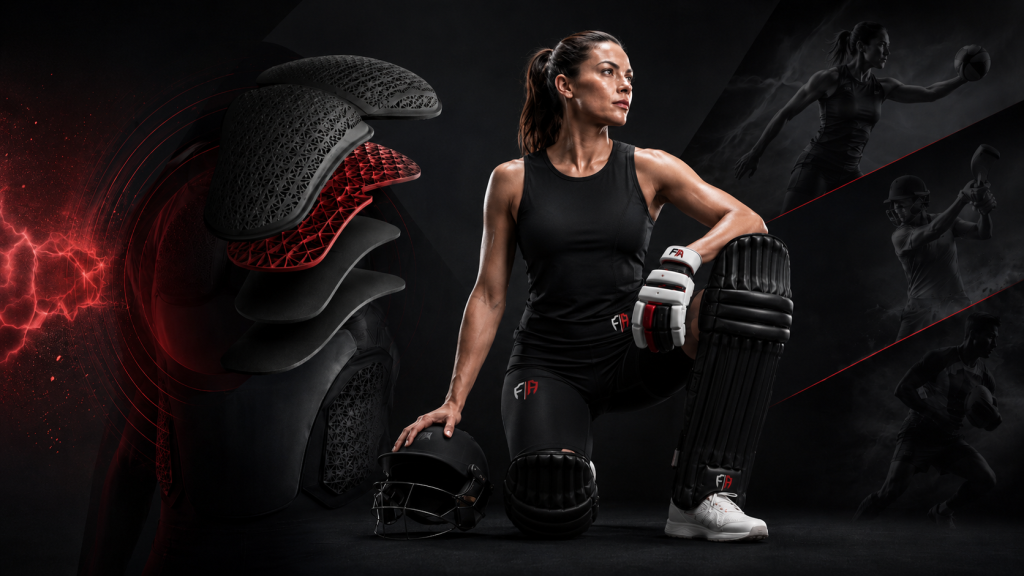
In Fempro Armour’s case, that includes protective technology designed to soften and mould to the wearer’s shape, female-specific product development, lightweight construction and material selected for impact absorption and force distribution.
The armour is also integrated into the garment. This removes the need for multiple external straps and helps keep the protection positioned where it is intended to sit.
That matters.
The best laboratory result in the world provides limited value if the protector moves away from the vulnerable area, does not fit properly or is so uncomfortable that the athlete refuses to wear it.
Durability must also be included in the value equation. Fempro Armour provides a 10-year warranty on its armour. A product costing more initially may deliver better value if it continues performing for years, while a cheaper product may need to be replaced repeatedly.
The correct calculation is not simply purchase price.
It is:
Total cost ÷ years of effective use = actual annual cost.
A $60 product replaced every season may eventually cost more than a higher-performing product backed by a long warranty. However what is the cost to the body, something no one can put a price onto it.
Comfort Is a Safety Feature
Comfort is often treated as a luxury. In protective equipment, it is part of performance. I often hear athletes say “you get used to the discomfort”. Should you really get used to it?
Uncomfortable equipment distracts the athlete. Poorly positioned straps can restrict movement, create pressure points and require constant adjustment. Bulky protection can affect running mechanics, batting movement, tackling technique or confidence.
Worse, athletes may loosen, modify or stop wearing uncomfortable protection altogether.
A comfortable protector that stays correctly positioned throughout training and competition has a major practical advantage over a theoretically protective product that remains inside the athlete’s kit bag.
This is particularly important for women and girls who have historically been expected to wear scaled-down or adapted equipment originally designed around male anatomy.
Making a male product smaller does not automatically make it female-specific. See how athletes describe the fit, comfort and performance of Fempro Armour.
Questions to Ask Before Buying Protective Gear
Before spending $50 or $500, ask the manufacturer or retailer:
- Has the product been independently impact tested?
- What testing method or standard was used?
- How much impact energy was applied?
- How much force was transmitted through the product?
- Does the company publish the actual results rather than simply saying “tested”?
- Which body shape, sex and sporting movement was the product designed around?
- Does the protection remain correctly positioned while the athlete moves?
- Is it designed for repeated impacts or a single impact?
- What is its expected service life?
- What warranty does the company provide?
Be cautious when a company says its product is “high impact,” “professional grade” or “tested to 160 km/h” without explaining the result.
Surviving contact with a fast-moving ball is not the same as proving how much force was transmitted through the protector.
The phrase “impact tested” is incomplete without the test conditions and outcome.
Without asking those questions, you are just playing russian roulette.
So, Is Expensive Protective Gear Worth It?
Sometimes.
Expensive protective gear is worth the money when the higher price is supported by:
- Independently measured impact performance
- Appropriate coverage
- Secure positioning
- Sport-specific and body-specific design
- Comfort that encourages consistent use
- Quality materials
- Proven durability
- A meaningful warranty
- Transparent information from the manufacturer
It is not worth the money when the price comes primarily from a famous logo, professional endorsements or unsupported marketing language.
Likewise, cheaper gear is not a bargain if it performs poorly, does not fit, constantly moves or gives the wearer a false sense of security.
Protective equipment should never be judged by price alone.
Do not ask only:
“How much does it cost?”
Ask:
“What evidence shows me how this product performs, how well will it fit my body, and how much force could still reach me?”
When manufacturers answer those questions openly, customers can finally compare protection instead of comparing price tags.