Impact Protection Explained – CE Level 1 vs CE Level 2: What Do Motorcycle Armour Ratings Really Mean?
When customers see a CE mark on protective armour, many assume it means the product provides excellent protection.
That is not necessarily true.
A CE rating confirms that a product has been tested against a defined European requirement and has met the minimum criteria for its stated protection level. It provides an important, independent benchmark—but it does not automatically tell you that the protector is highly effective, suitable for every impact or better than every other CE-rated product.
There can be a substantial performance difference between two protectors carrying the same rating.
To make a properly informed decision, customers need to understand what CE Level 1 and CE Level 2 mean, which standard was used, how the protector was tested and, most importantly, how much force was still transmitted through it.
What Does “CE Rated” Mean?
CE marking is used for personal protective equipment sold within the European market. For motorcycle impact protectors, the relevant standards sit within the EN 1621 series.
Different parts of EN 1621 apply to different areas and types of protection:
- EN 1621-1 applies to protectors for areas such as the shoulders, elbows, hips and knees.
- EN 1621-2 applies to back and lumbar protectors.
- EN 1621-3 applies to motorcycle chest protectors.
- EN 1621-4 applies to mechanically activated inflatable protectors.
This distinction matters because Level 1 does not represent one universal force limit across every body area.
The number following EN 1621 identifies the type of protector that has been assessed. The performance level—Level 1 or Level 2—then indicates which minimum requirement it achieved within that particular standard.
How Is Motorcycle Armour Impact Tested?
Although the exact equipment and procedures vary between standards, the basic principle is similar.
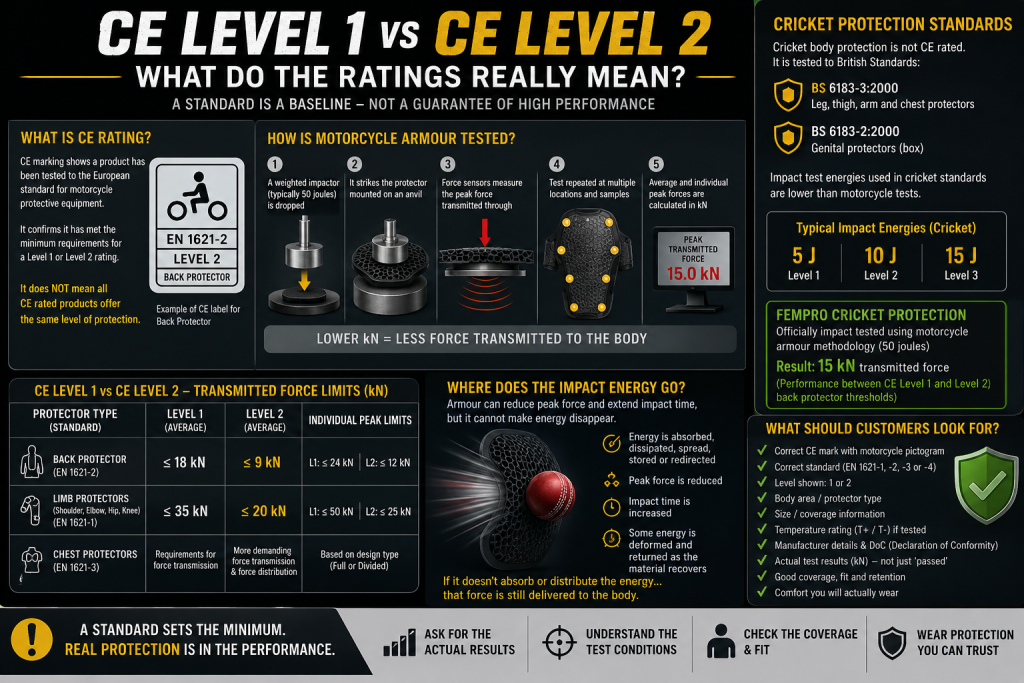
The protector is placed over a test anvil connected to force-measuring equipment. A weighted impactor is dropped onto the protector with a controlled amount of impact energy. For many non-inflatable EN 1621 tests, the nominal impact energy is approximately 50 joules.
The equipment beneath the protector records the peak force that travels through the armour.
That result is normally expressed in kilonewtons, abbreviated as kN.
One kilonewton equals 1,000 newtons of force. For customers, the most important principle is simple:
The lower the transmitted-force result, the less peak force passed through the protector during that laboratory test.
The armour is tested more than once and at different locations. Depending on the standard, it may also undergo conditioning for moisture, ageing or temperature before additional impacts are conducted.
The test does not recreate every possible motorcycle accident. It creates a controlled and repeatable way to compare performance against an established baseline.
What Is the Difference Between CE Level 1 and Level 2?
Level 1 is the lower protection classification. Level 2 requires stronger impact attenuation.
However, the limits depend on which EN 1621 standard applies.
Limb protectors: EN 1621-1
For shoulder, elbow, hip and knee armour:
- Level 1: average transmitted force must be below 35 kN.
- Level 2: average transmitted force must be below 20 kN.
There are also limits on individual impacts, not only the calculated average.
Back protectors: EN 1621-2
Back protectors have lower permitted transmitted-force limits:
- Level 1: average transmitted force must be below 18 kN, with no individual result above 24 kN.
- Level 2: average transmitted force must be below 9 kN, with no individual result above 12 kN.
This means that a back protector sitting just inside the Level 2 limit may transmit roughly half the average peak force permitted for Level 1.
That is not a small difference.
Chest protectors: EN 1621-3
Chest protectors are assessed under a separate standard because chest protection involves more than simply placing soft padding over the body.
EN 1621-3 recognises full and divided chest-protector designs. Level 1 focuses on force-transmission performance, while Level 2 includes more demanding requirements relating to both force transmission and force distribution.
This distinction is important because the result should not only be judged by how much force comes through one point. How effectively the protector spreads a concentrated impact over a larger area can also affect its protective performance.
A Standard Is a Baseline—not Proof of Exceptional Performance
This is where customers are often misled.
A standard establishes the requirements a product must satisfy to receive a particular classification. It does not say that every product carrying that classification performs equally.
Imagine two back protectors tested under EN 1621-2:
- Protector A records an average transmitted force of 17.8 kN.
- Protector B records an average transmitted force of 10 kN.
Both may qualify as Level 1, yet Protector B allows substantially less peak force through during the test.
The label alone does not reveal that difference.
The same issue applies to Level 2. One protector may only narrowly pass the Level 2 threshold, while another may perform far below it. Both can display the same level number.
That is why “CE Level 2” should not be the end of the customer’s investigation. It should be the beginning.
Where Does the Impact Energy Go?
Protective armour cannot make impact energy vanish.
When an impact occurs, the material may deform, compress and slow the impact. Depending on its construction, it may:
- absorb and dissipate part of the energy;
- temporarily store energy through deformation;
- spread the load over a larger surface area;
- reduce the peak force;
- extend the time over which the force is delivered; and
- return some energy as the material recovers or rebounds.
Slowing the impact and reducing its peak force can be highly important. A sharp force delivered over a very short period can be more damaging than a lower force distributed over a longer period and a wider area.
However, saying that armour “absorbs impact” is not enough.
Customers should ask how the claim was measured. A transmitted-force result does not measure every component of the energy pathway, but it does provide a practical indication of how much peak force reached the equipment beneath the protector under the specified test conditions.
This is why the actual kN result matters.
What Should You Look for on a CE Protector?
A genuine certification label should provide more information than a large CE logo printed on the packaging.
Depending on the product, customers should look for:
- the CE mark;
- the motorcycle-rider pictogram;
- the relevant standard, such as EN 1621-1, EN 1621-2 or EN 1621-3;
- the achieved protection level: 1 or 2;
- the protected body area or protector type;
- the coverage or size classification where applicable;
- optional temperature markings such as T+ or T-, where those tests have been passed;
- the manufacturer’s identification and product reference; and
- access to the product’s instructions and EU Declaration of Conformity.
The motorcycle pictogram matters. A generic CE logo without a standard number, protection level and relevant product information does not give customers enough evidence to understand what was actually tested.
Customers should also be careful not to confuse the certification of the garment with the certification of its removable armour inserts. Motorcycle clothing and the impact protectors installed inside it may be assessed under different standards.
Questions Every Customer Should Ask
Before purchasing impact protection, ask:
- Which exact standard was used?
“CE tested” is too vague. - Is it Level 1 or Level 2?
Level 2 generally represents stronger protection, but the applicable thresholds depend on the standard and body area. - What was the actual average transmitted-force result?
Do not settle for “passed.” - What was the highest individual result?
An average can hide variations between impacts. - Was it independently tested by an accredited laboratory?
- Was the complete product certified, or only the armour material or insert?
- How much of the body does it cover?
Excellent material cannot protect an area it does not cover. - Does it remain correctly positioned during movement and impact?
- Was it tested after moisture, heat, cold or ageing conditioning?
- Is the protection practical enough to be worn consistently?
Protection that is uncomfortable, poorly fitted or repeatedly moves away from the intended body area may not perform as expected in real use.
What About Protective Equipment in Cricket?
CE Level 1 and Level 2 are motorcycle protection classifications. They should not be presented as cricket certification levels.
Cricket has its own British Standards, including:
- BS 6183-2:2000 for cricketers’ genital protectors; and
- BS 6183-3:2000 for leg protectors and certain thigh, arm and chest protectors.
However, cricket protection is not commonly communicated to consumers through the same clear Level 1 and Level 2 impact-rating structure used for motorcycle armour. Many cricket products are sold without prominently disclosing an actual transmitted-force result in kilonewtons.
That makes transparent testing particularly valuable.
Fempro Armour’s cricket protection has undergone official impact testing using a motorcycle-armour test methodology because it provides an established, controlled framework for measuring transmitted force. The cricket protection recorded a result of approximately 15 kN under the relevant test conditions.
When compared numerically with the 18 kN Level 1 and 9 kN Level 2 average limits used for EN 1621-2 back protection, 15 kN sits between those two thresholds.
This comparison does not mean the cricket product is CE certified for motorcycling or that it carries a motorcycle Level 1 or Level 2 rating. It means the established motorcycle test methodology was used as a technical benchmark to quantify its impact performance.
That distinction must remain clear.
CE Certification Is Important—but It Is Only One Part of Protection
CE certification gives customers a valuable baseline. It shows that a product has been assessed against defined requirements rather than relying solely on marketing language.
But a passing grade is not the same as outstanding performance.
A customer should evaluate:
- the actual transmitted force;
- the applicable standard;
- force distribution;
- protective coverage;
- fit and retention;
- performance after environmental conditioning;
- repeated-impact capability;
- comfort; and
- whether the protector remains in place during real movement.
Do not buy protection because the packaging uses words such as “advanced,” “high impact,” “shock absorbing” or “professional.”
Ask for the numbers.
A rating tells you which line the product crossed. The actual test result tells you how far beyond—or how close to—that line it performed.
Explore Fempro Armour Protection
Learn more about Fempro Armour’s independently tested protection:
- Motorcycle body armour: CLICK HERE
- Cricket protection: CLICK HERE
- AFL, NRL and rugby protection: CLICK HERE