
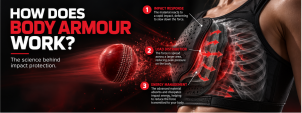
How Does Body Armour Work? The Science Behind Impact Protection
Not all body armour protects in the same way. Understanding what happens during an impact could change how you choose protective equipment.
When an athlete is struck by a cricket ball, tackled on the rugby field, or thrown from a motorcycle, the body is exposed to forces that can cause significant injury.
But what actually happens when something hits your body? And how does protective armour help reduce the force of that impact?
Most people assume that thicker, harder or heavier protection must be better. However, the science of impact protection is far more complex.
At Fempro Armour, we believe athletes deserve to understand the technology protecting their bodies, not simply trust a marketing label.
Let’s explore how body armour works, what happens to impact energy, and why the right materials, engineering and fit make a difference.
What Happens to Your Body During an Impact?
Imagine a cricket ball travelling towards an athlete at high speed.
When the ball strikes the body, its momentum changes rapidly, creating a force at the point of contact.
Without effective protection, that force is applied directly to the tissues beneath the impact area, potentially causing bruising, soft tissue damage or more serious injuries.
The severity of injury depends on several factors:
- Impact speed: How quickly the object or athlete is moving.
- Impact energy: The energy associated with the moving object.
- Contact area: Whether the force is concentrated in a small area or distributed across a larger surface.
- Impact duration: How quickly the force is delivered.
- Body location: Which tissues, muscles, bones or organs receive the impact.
This is why a cricket ball striking the ribs can produce a very different injury from a rugby tackle across the shoulder.
And it is why protective armour needs to do more than simply create a barrier.
How Does Body Armour Actually Protect You?
Effective impact armour works by managing the energy and forces generated during a collision.
The goal is to reduce the peak force and pressure transmitted to the body beneath the protector.
Depending on its construction, protective armour can achieve this through three important mechanisms.
1. Slowing Down the Impact
When an object strikes a protective material, that material can deform or compress.
This deformation increases the time over which the impact occurs.
Why does that matter?
Because rapidly stopping a moving object generally produces a higher average force than bringing it to a stop over a longer period.
Think about the difference between dropping an object onto concrete and dropping it onto a suitably designed energy-absorbing surface.
The object encounters a different stopping process.
In protective equipment, controlling that process can help reduce the peak force reaching the athlete.
2. Distributing the Impact Across a Larger Area
Consider being poked in the ribs with one finger compared with being pushed gently across a broader area with an open hand.
The sensation is different because pressure depends on how force is distributed.
A concentrated impact can create high pressure over a small area.
Well-engineered armour can help spread the load across a larger surface rather than leaving it concentrated directly beneath the impact point.
This is particularly relevant when protecting vulnerable areas such as the ribs, sternum, shoulders and thighs.
However, not every material distributes loads equally. The geometry, thickness, stiffness and construction of a protector all affect its performance.
3. Absorbing and Dissipating Impact Energy
Impact energy does not simply disappear when an athlete wears armour.
Some energy can be absorbed and dissipated through the material’s internal deformation, while some may be temporarily stored and returned as the material recovers.
The effectiveness of armour depends partly on how it manages these processes.
Importantly, protective equipment cannot eliminate every force associated with a collision.
Its purpose is to reduce the forces transmitted to the protected area under the conditions for which it was designed.
What Makes Smart Impact Armour Different from Traditional Padding?
Traditional protective padding often relies on foam compression to cushion an impact.
This approach can be effective, but performance varies considerably between materials.
Some conventional foams may compress too far under a sufficiently severe impact, leaving less capacity to manage the remaining load. This is sometimes called bottoming out.
Advanced impact materials can be engineered to behave differently.
Fempro Armour uses German-engineered viscoelastic polyurethane impact technology.
Viscoelastic materials combine characteristics of both elastic and viscous responses. Their resistance to deformation can depend on how quickly they are loaded.
During ordinary movement, our armour is designed to remain soft, flexible and body-conforming.
During a rapid impact, the material responds differently, helping manage the incoming energy and reduce transmitted force.
This rate-sensitive behaviour is one reason advanced impact protection can be developed without relying exclusively on bulky, rigid construction.
The aim is to deliver effective protection while preserving the movement athletes need to perform.
What Happens When Fempro Armour Takes a Hit?
Our technology is engineered around three interconnected principles:
Stage 1 — Impact response
When the armour experiences a rapid impact, its viscoelastic structure responds to the load by slowing the force down, resisting deformation in a way that helps control the impact.
Stage 2 — Load distribution
The construction of the armour helps distribute the applied load across the protective area, rather than allowing all the pressure to remain concentrated at one point.
Stage 3 — Energy management and recovery
As the armour compresses and deforms, energy is managed through the material’s response. After the impact, its memory-foam characteristics allow it to recover towards its original shape.
Our protectors are designed for repeated impacts, rather than being single-use cushioning systems.
This combination of flexibility, impact attenuation and shape recovery is central to Fempro Armour’s approach to athlete protection.
Does Thicker Armour Mean Better Protection?
Not necessarily.
Thickness alone cannot tell you how much protection a product provides.
Two protectors with similar dimensions may behave very differently when exposed to the same impact.
Their performance can depend on:
- Material composition and density.
- Rate-sensitive properties.
- Internal structure and geometry.
- Ability to distribute loads.
- Resistance to bottoming out.
- Performance under repeated impacts.
An advanced, relatively low-profile protector may outperform a thicker conventional pad under particular test conditions.
But this should be demonstrated through comparative testing rather than assumed from the material’s appearance.
The important question is not how thick the armour is. It is how much force the armour allows through.
How Do You Know Whether Body Armour Actually Works?
One of the most useful ways to evaluate impact protection is through controlled laboratory testing.
For example, European motorcycle impact-protection standards in the EN 1621 series use defined impact conditions to measure the force transmitted through a protector.
The results are typically expressed in kilonewtons (kN).
A lower transmitted-force reading under the same test conditions indicates better attenuation of peak force.
However, a laboratory result needs to be understood in context.
A protector’s performance under a 50-joule laboratory impact does not necessarily predict what will happen in every sporting collision.
At Fempro Armour, we use recognised European impact-testing methodologies as benchmarks for evaluating our protective technology.
Our motorcycle products are certified to applicable motorcycle CE standards, while products developed for other sports may be tested using methodologies derived from those standards without being motorcycle CE-certified.
This distinction matters because tested to a methodology and certified to a standard are not the same thing.
We believe athletes should know what has been tested, how it was tested and what the results mean.
Why Does the Fit of Protective Armour Matter?
Even high-performing armour has limitations if it does not cover the intended area or stay correctly positioned.
Imagine wearing a chest protector that shifts upwards during running, leaving part of the ribs exposed.
Or an excessively flat protector that creates pressure points and gaps around the female chest.
The material may perform well in a laboratory, but the athlete may not receive the intended coverage during sport.
This is why anatomical design matters.
Women’s and men’s bodies differ in ways that can affect protective garment fit, including chest contours, proportions and body shape.
For female athletes, chest and breast protection requires particular consideration.
At Fempro Armour, we design protection around the athlete rather than expecting the athlete to adapt to poorly fitting equipment.
Our approach considers fit, protective coverage, freedom of movement and how the armour is held in position during activity.
Because effective protection is not just about what the material does when it is struck.
It is also about whether the armour is in the right place when the impact happens.
Can Body Armour Prevent Injuries?
Protective armour can reduce transmitted impact forces, but no product can guarantee that an athlete will avoid injury.
Injury outcomes depend on the severity, direction and location of the impact, as well as the individual’s anatomy and other factors.
Body armour is also not a substitute for correct sporting technique, appropriate training, injury management or adherence to safety rules.
It should be viewed as one component of a broader approach to athlete safety.
The objective is to help manage impact exposure and reduce potential harm without unnecessarily restricting sporting performance.
The Future of Protection Is Smarter, Not Simply Harder
Athletes are moving faster, training harder and competing in increasingly demanding environments.
Protective equipment must continue evolving alongside them.
The future of impact protection is not simply about adding more padding.
It is about understanding the forces athletes experience, developing materials that respond appropriately, testing their performance and creating garments that fit the people wearing them.
At Fempro Armour, that philosophy drives our work across cricket, rugby, AFL, motorcycling and other impact activities.
We believe athletes should never have to choose between protection, comfort and freedom of movement.
Because protection shouldn’t just cover the body. It should be engineered to work with it.
Discover the Science Behind Your Protection
Explore Fempro Armour’s advanced impact-protection technology and learn why material performance, laboratory testing and anatomical fit matter.
Fempro Armour — Engineered to protect. Designed to move.
Click HERE to find your product needs.