
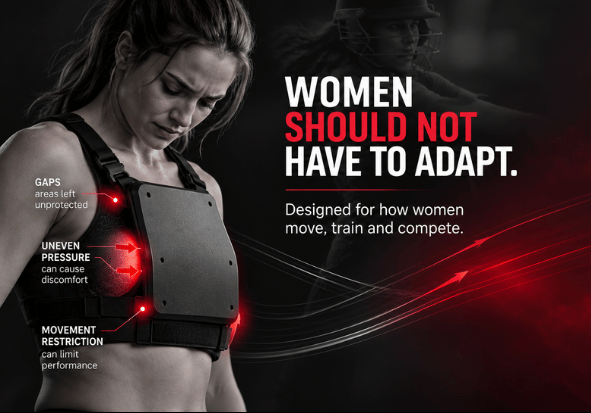
Why Female-Specific Design Matters: Women Should Not Have to Adapt
WOMEN SHOULD NOT HAVE TO ADAPT.
Designed for how women move, train and compete.
For decades, women have been expected to compete, train and perform in protective sports equipment that was never designed with their bodies in mind.
From cricket and rugby to AFL, motorcycling and other high-impact sports, female athletes have too often faced the same problem: protective gear designed primarily around male anatomy, then reduced in size or adjusted to accommodate women.
But making something smaller does not automatically make it suitable for a woman’s body.
Women should not have to change how they move to accommodate their protective equipment. Protective equipment should be designed around them.
At Fempro Armour, we believe female-specific sports protection is not a luxury, a marketing trend or simply another product category.
It is a fundamental design consideration that deserves greater attention across the sporting industry.
1. The Problem With Traditional Protective Sports Equipment
Sport has evolved. Women’s participation, competition standards and professional opportunities have grown enormously.
Yet one important part of the sporting experience has not always kept pace: protective equipment.
Historically, much of the equipment used across contact and impact sports has been developed around male body dimensions.
This becomes a problem when protective gear is expected to accommodate differences in chest shape, breast anatomy, waist proportions, hips, shoulders and overall body structure.
Female athletes can experience:
- Protective pads that shift during movement.
- Chest protectors that do not comfortably accommodate breast tissue.
- Straps that dig into the shoulders, chest or ribs.
- Excessive bulk around the torso or thighs.
- Restricted movement when bending, rotating or reaching.
- Gaps or inconsistent coverage around intended impact zones.
- Discomfort that distracts from training and competition.
These are not simply cosmetic concerns.
A protective product needs to fit the athlete and remain appropriately positioned while they perform the movements required by their sport.
If protective equipment does not fit properly, can we really expect it to perform as intended in every situation?
That is a question the sporting industry should be asking more often.
2. Why Female Anatomy Matters in Protective Equipment Design
Women are not simply smaller versions of men.
While body shapes vary considerably between individuals, female anatomy introduces specific considerations  that should influence the design of protective sports gear.
Breast and chest anatomy
One of the most obvious considerations is the breast and chest region.
Traditional chest protection may be flat, rigid or shaped around body proportions that do not comfortably accommodate breast tissue.
Depending on the design and the athlete, this can create uneven pressure, gaps, shifting or movement restrictions.
Effective female-specific chest protection should consider anatomy, body shape, coverage and how the equipment behaves during movement.
Waist, hips and thigh proportions
Female body proportions also matter when designing protective equipment for the lower body.
In cricket, for example, traditional thigh guards may depend on straps to hold separate protective pads in position.
If the fit is unsuitable, the pads may move, overlap awkwardly or create unnecessary bulk as the athlete runs, bends and bats.
A better approach considers the shape of the garment, the placement of the protective material and how the complete system moves with the athlete.
Shoulder and torso movement
Female-specific body armour must also consider the range of movements required in different sports.
A cricketer needs to rotate through a batting stroke. A rugby player must tackle, turn and accelerate. A motorcyclist needs to comfortably maintain a riding position while moving the upper body.
Protective equipment should accommodate these movements without unnecessary restriction.
Female-specific design is not about assuming every woman has the same body shape. It is about recognising that anatomical differences and individual variation must be considered from the beginning.
3. Why Fit Is Just as Important as the Protective Material
When athletes purchase body armour, they often focus on the material, the thickness of the padding or whether a product has been tested against a recognised standard.
These are important considerations, but they are not the entire picture.
A protective material may perform well in a controlled impact test, yet its effectiveness as part of a complete garment also depends on correct placement, coverage and fit.
Consider a chest protector that moves out of position when an athlete bends or rotates.
Even if the protective material has demonstrated good impact-energy absorption in laboratory testing, that test does not guarantee the intended area will remain covered during every sporting movement.
This is why protective equipment design must consider the complete system, not just the armour inside it.
Good design asks:
- Does the protection sit over the intended impact area?
- Does it remain in position during realistic sporting movements?
- Does it accommodate different body shapes?
- Can the athlete move comfortably and naturally?
- Is the garment sufficiently stable without unnecessary compression?
- Has the impact performance been tested under relevant conditions?
These questions are particularly important when designing women’s chest protectors, cricket protective gear and body armour for female athletes.
Protection is not just about what the material can absorb. It is also about whether that material is correctly positioned when it is needed.
4. Comfort and Confidence Are Part of the Sporting Experience
Imagine preparing to face a fast bowler while constantly adjusting a thigh guard.
Or lining up for a tackle while feeling a chest protector pressing uncomfortably against your body.
Or riding a motorcycle for hours while body armour shifts or creates pressure points.
In each situation, the athlete is dealing with something beyond the demands of the sport itself.
Poorly fitting equipment can create unnecessary distractions and discomfort.
Although the performance benefits of any particular protective product require appropriate testing, comfort, movement and confidence are important design goals.
An athlete should be concentrating on her next movement, not constantly thinking about her protective gear.
For young female athletes in particular, comfortable, appropriately fitted equipment also contributes to a sporting environment where their physical needs are recognised and taken seriously.
When we talk about advancing women’s sport, equipment design deserves to be part of that conversation.
5. Breast Protection in Women’s Sport: An Overlooked Conversation
Breast health is an important part of female athlete wellbeing, yet discussions about protection from direct sporting impacts remain relatively limited.
The female breast contains glandular, fatty and connective tissues, with individual differences in size, shape and sensitivity.
During activities such as running and jumping, breast movement can cause discomfort or pain, which is why appropriate sports bra support is important.
However, breast support and breast impact protection are not the same thing.
A sports bra is primarily designed to support breast tissue and manage breast movement during exercise.
An impact protector is designed to manage certain external forces applied to a specific area of the body.
Both have different functions, and one should not automatically be considered a replacement for the other.
Research into breast injuries in contact sports and the effectiveness of breast protective equipment is still developing. It is therefore important not to assume that wearing a chest protector has been proven to prevent breast injuries.
Nevertheless, there are important questions worth investigating.
How often do female athletes experience direct impacts to the breast or chest?
How many report discomfort or injury?
Does existing protective equipment adequately accommodate breast anatomy?
And how can the next generation of female-specific sports equipment be designed and evaluated more effectively?
These questions deserve scientific investigation, athlete involvement and thoughtful engineering.
6. Why the Technology Behind Women’s Body Armour Matters
Female-specific design is only one part of effective sports protection.
The next consideration is the protective material itself.
Traditional protective equipment can use combinations of rigid shells, foams and padding, depending on the sport and intended impact risks.
At Fempro Armour, we use advanced German-engineered viscoelastic impact armour.
This engineered material is designed to remain flexible during normal movement while responding to impact by absorbing and dissipating energy.
Its purpose is to help reduce the force transmitted through the protective material under relevant impact conditions.
Combined with anatomically considered garment design, this technology provides an alternative approach to conventional bulky padding.
But there is an important distinction.
No protective material can eliminate injury risk, and impact-test results must always be interpreted according to the conditions under which testing was performed.
Responsible protective equipment development means considering material performance, impact conditions, body coverage, fit and the demands of each sport.
A certification label alone does not explain every aspect of protective performance.
Athletes deserve clear information about what has been tested, how it was tested and what those results mean.
7. Female-Specific Design Must Be Backed by Research, Not Marketing
Calling a product “designed for women” is easy.
Demonstrating why its design is appropriate requires more work.
Meaningful female-specific protective equipment development should involve female athletes, anatomical considerations, engineering, relevant impact testing and practical feedback.
This includes understanding the realities of sporting movement, not merely taking measurements while an athlete stands still.
It also means recognising the significant differences between individual female athletes.
A junior cricketer, an elite rugby player and an experienced motorcyclist do not necessarily have identical protection requirements.
Body shape, fit preferences, sporting movements and exposure to impact may all differ.
For Fempro Armour, athlete-centred development is central to our approach.
Our goal is to bring together female-specific design, advanced materials and evidence-informed product development to improve the options available to women participating in sport.
We believe the future of women’s protective sports equipment should be built on measurable performance, appropriate testing and genuine consideration of the athlete.
Not assumptions.
Not marketing shortcuts.
And not simply smaller versions of men’s gear.
8. What Should Female Athletes Look for When Buying Protective Gear?
Whether choosing a women’s cricket chest protector, rugby body armour or female motorcycle protection, athletes should look beyond appearance and product descriptions.
Consider these questions before purchasing:
Is the equipment designed for female anatomy?
Look for details about how the product accommodates the chest, waist, shoulders or hips rather than relying only on a women’s size label.
Does it remain correctly positioned during movement?
Try movements relevant to your sport. Check for shifting, exposed areas and pressure points.
What kind of impact testing has been conducted?
Ask whether the product has been tested, against which methodology and for what intended application.
Does the protective material restrict movement?
Protection should be compatible with the movements required during training and competition.
Is it permitted under the rules of your sport?
Protective equipment requirements and approvals vary between sporting organisations.
Does the manufacturer explain the technology clearly?
Look for transparent information about materials, testing, limitations and intended use.
Female athletes should be able to make informed decisions based on more than colour, branding or broad claims about safety.
9. The Future of Women’s Sport Must Include Better Equipment Design
Women’s sport is not simply a smaller version of men’s sport.
Female athletes deserve equipment designed with their anatomy, sporting movements and protection requirements in mind.
That does not mean every woman requires the same design, or that all traditional equipment is unsuitable.
It means the starting point for product development should include the people who will actually wear the equipment.
At Fempro Armour, our mission extends beyond creating protective products.
We want to challenge outdated assumptions, support research, improve awareness and help build a sporting environment where protection and performance are considered together.
Because female athletes should not have to choose between comfortable equipment and equipment intended to protect them.
They should not have to continually adjust, compromise or tolerate unnecessary restrictions.
And they should not have to accept that their needs are an afterthought.
Women should not have to adapt.
Protective equipment should evolve with them.
Discover Protection Designed Around Female Athletes
Explore Fempro Armour’s approach to female-specific impact protection, combining anatomically considered design with advanced materials and athlete-focused innovation. Click HERE to explore of products.
Designed for how women move, train and compete.
Fempro Armour — Protecting Athletes Today, for the Sporting Future They Deserve.