AC Joint Guards: Protecting the Shoulder After an Acromioclavicular Injury
An acromioclavicular joint injury — commonly called an AC joint injury or shoulder separation — is one of those injuries that can look relatively small from the outside but have a significant effect on an athlete’s ability to train, compete and tolerate contact.
The AC joint sits at the top of the shoulder where the collarbone (clavicle) meets the acromion, part of the shoulder blade. In contact sports, an AC injury commonly occurs when an athlete lands directly on the point of the shoulder or receives a forceful impact to the area.
That mechanism is common in rugby, AFL, rugby league, cycling and motor sport: shoulder hits ground, another athlete, or another hard surface — and the force travels directly through the AC joint.
Depending on the severity, the ligaments supporting the joint can be stretched or torn, allowing the clavicle and shoulder blade to separate to varying degrees.
Recovery doesn’t necessarily mean the shoulder is forgotten
Lower-grade AC injuries are commonly managed without surgery, using an initial period of protection followed by progressive movement, strengthening and rehabilitation. More severe injuries may require longer rehabilitation and, in some circumstances, surgical reconstruction.
Recovery varies enormously according to the grade of injury and the athlete’s sport.
Research demonstrates that athletes generally have high rates of returning to sport following AC joint injuries, but return-to-sport timelines vary considerably. A recent systematic review found that nonoperative managed athletes returned considerably faster on average than surgically treated athletes, while postoperative return-to-sport protocols commonly extend for several months.
But there is an important distinction:
Being cleared to play does not mean the shoulder can no longer be injured.
Once an athlete returns to contact sport, the same mechanism that produced the original injury still exists. They can still land directly onto that shoulder, collide with another athlete or take an impact directly over the AC joint.
Some athletes also experience ongoing tenderness, weakness, altered shoulder mechanics or instability following an AC injury. Persistent pain, post-traumatic arthritis and chronic instability have all been reported following AC joint trauma.
That is where post-injury impact protection becomes particularly relevant.
The traditional custom-moulded AC joint guard
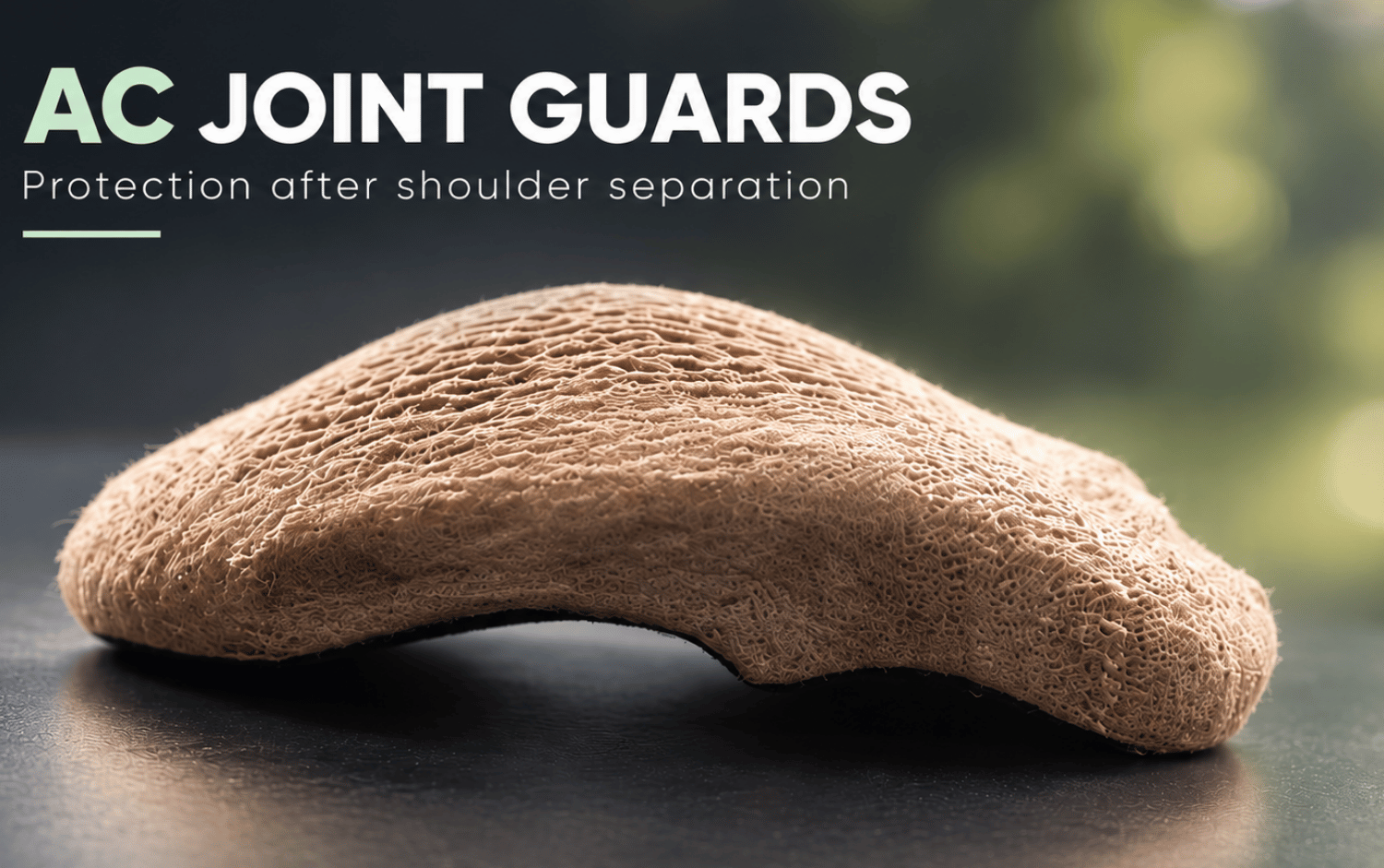
Athletes returning to contact sport after an AC injury are sometimes fitted with a custom-moulded thermoplastic shoulder guard, usually manufactured or fitted by a physiotherapist or other appropriately trained clinician.
The principle is sensible.
A rigid thermoplastic shell is moulded around the shoulder while creating a raised or relieved area over the injured AC joint. When something strikes the shoulder, the intention is for the shell to bridge over the sensitive area and spread the load across a larger surrounding surface rather than allowing the impact to land directly on the prominent AC joint.
Think of it almost like creating a protective bridge around the injury site.
Custom moulding can be particularly useful when an athlete has an unusual shoulder shape, a pronounced post-injury deformity or requires highly specific protection prescribed as part of their rehabilitation.
But it also has limitations.
Because thermoplastic is relatively rigid, it primarily manages an impact through load distribution and deflection. It does not behave like an impact-absorbing viscoelastic material whose primary job is to deform and dissipate impact energy.
Fit can also change with movement. The shoulder is not a static surface. During running, tackling, reaching, falling and overhead movement, the scapula, clavicle and surrounding musculature are constantly moving.
A rigid guard therefore needs to be positioned and secured carefully if it is to remain over the intended area.
A different approach: Fempro & Bropro Armour’s AC Crash Pad
The AC Crash Pad approaches the same problem differently.
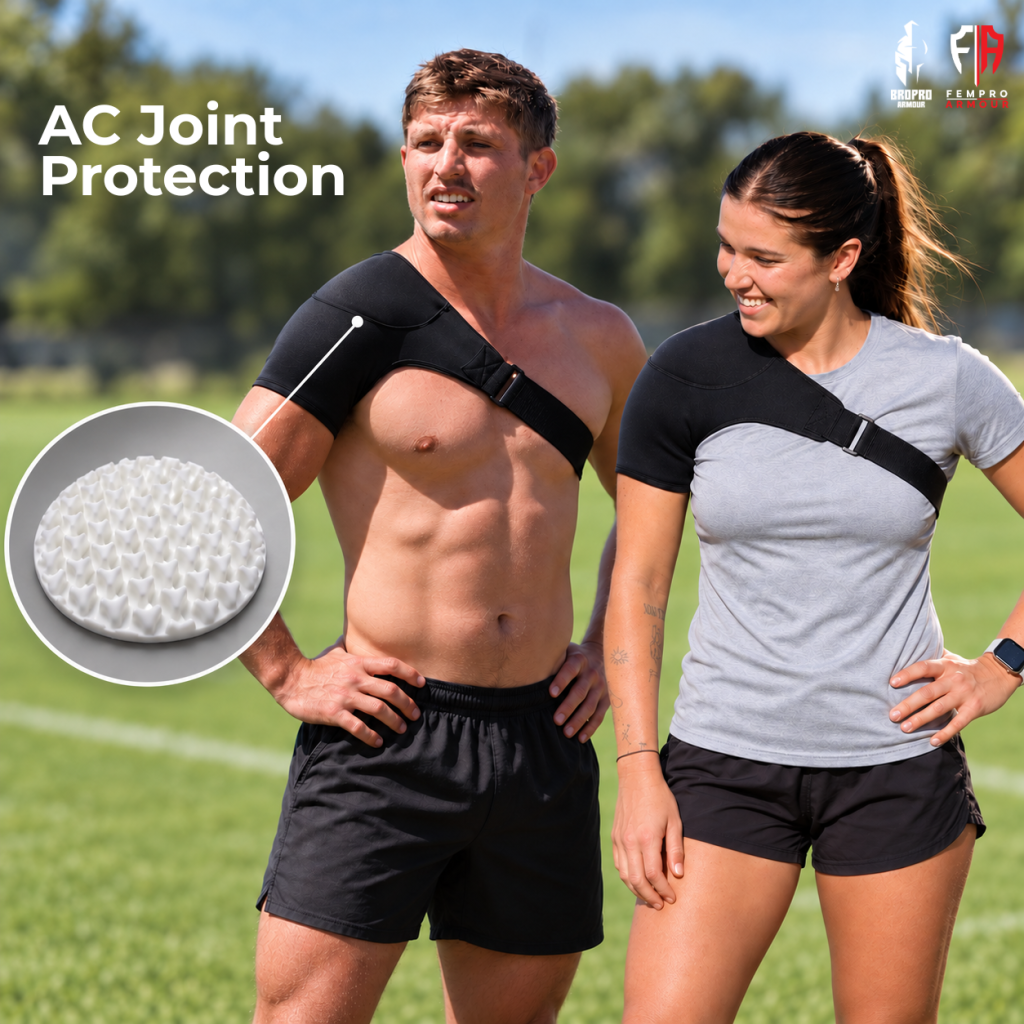
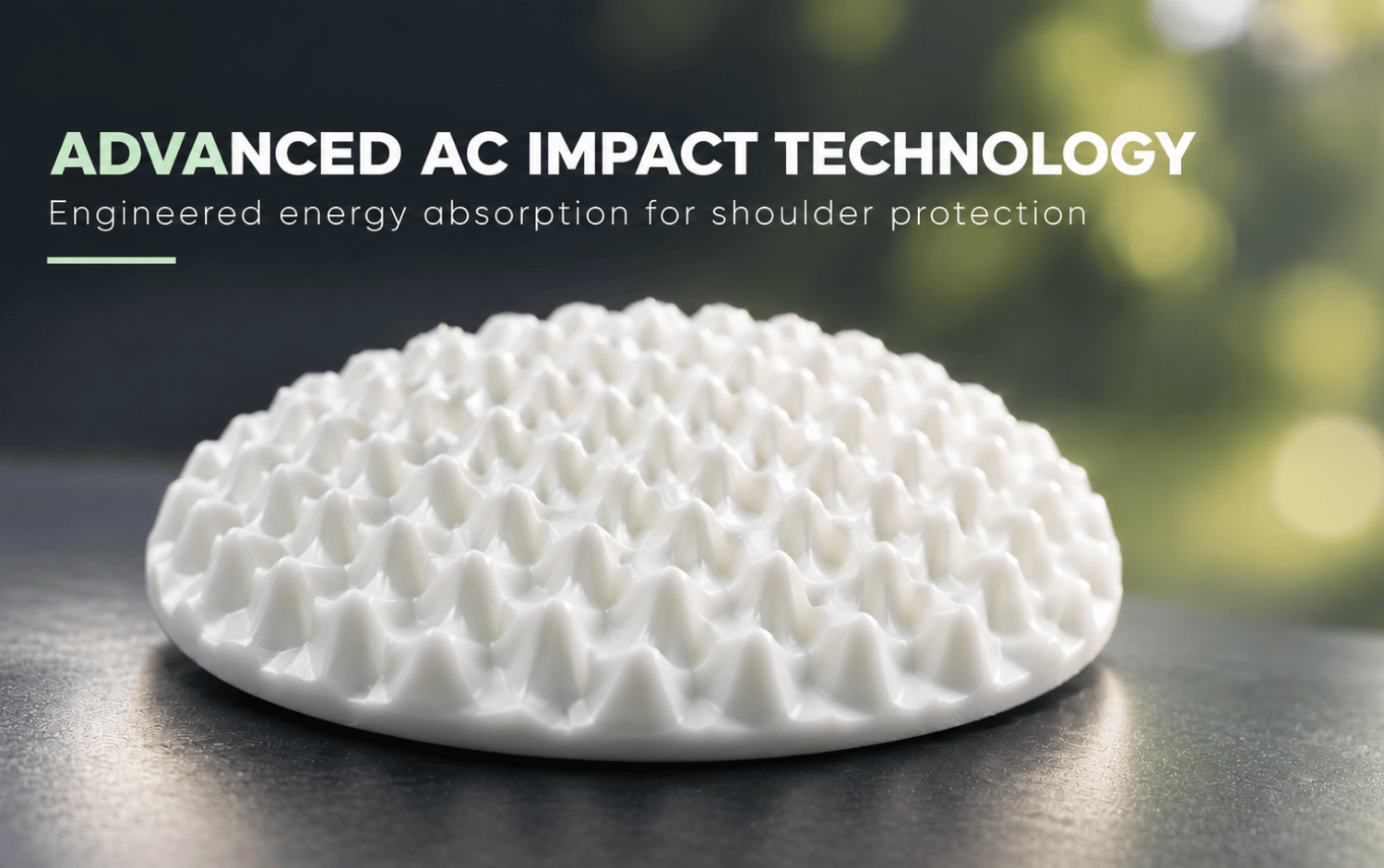
Rather than using a hard shell alone to bridge over the AC joint, the system combines a shoulder-specific sling with Fempro Bropro Armour’s viscoelastic impact armour technology positioned over the vulnerable area.
The material is soft and flexible during normal movement, allowing it to conform closely to the body rather than behaving like a rigid plate.
When subjected to an impact, however, the material reacts differently: its structure resists rapid deformation, helping absorb, dissipate and distribute impact energy across the armour rather than allowing the entire force to concentrate on one small point.
That distinction matters.
A hard thermoplastic guard and a viscoelastic impact protector are not simply two versions of the same product.
They use different approaches to impact management.
| Custom thermoplastic AC guard | Fempro Armour AC Crash Pad |
|---|---|
| Individually moulded to the athlete | Anatomically positioned through the sling system |
| Rigid construction | Flexible viscoelastic armour |
| Can create clearance over a sensitive AC joint | Sits over and protects the impact area |
| Primarily redistributes/bridges load around the joint | Designed to absorb, dissipate and spread impact energy |
| Usually manufactured individually by a physio | Reusable protective equipment |
| Fit depends heavily on moulding and strapping | Sling sizes allow the same armour to be positioned securely |
| May restrict or interfere with movement if bulky | Designed around movement and sports participation |
Neither approach replaces rehabilitation, medical assessment or appropriate return-to-play clearance.
And an important point needs to be made: no shoulder guard can make an athlete immune to another AC joint injury.
Protection is about managing exposure to impact — not eliminating risk.
Why protection still matters after rehabilitation
One of the biggest mistakes in sport is thinking about protection only during the acute injury period.
The more useful question is:
What happens when the athlete is healthy enough to return to exactly the environment that caused the injury?
A rugby player may once again make dozens of tackles. An AFL player may be driven into the ground. A motocross rider may land directly onto the shoulder.
The athlete may have completed rehabilitation and regained strength, but the laws of physics haven’t changed.
For athletes returning after an AC injury, reducing direct impact exposure to a previously injured and potentially sensitive area may therefore become part of a broader return-to-sport strategy alongside strength, mobility, technique and load management.
Rehabilitation research also emphasises restoring scapular control and shoulder function before full sporting activity — another reminder that AC joint recovery involves more than simply waiting for pain to disappear.
Protection shouldn’t stop when rehabilitation does
At Fempro Armour, our philosophy is not to tell athletes that protective equipment prevents every injury. It can’t.
Our job is to engineer equipment that changes what happens when impact occurs.
The AC Crash Pad was developed around that principle: comfortable enough to move with the athlete, positioned over the vulnerable AC region, and using impact-responsive armour technology rather than relying purely on a rigid external shell.
For an athlete who has suffered an AC injury, the goal after rehabilitation isn’t to become afraid of another collision.
It’s to return prepared.
Rehabilitation rebuilds the shoulder.
Training rebuilds performance.
Protection adds another layer between the athlete and the next impact.
That is where the Fempro & Bropro Armour AC Crash Pad fits. Check for Bropro AC Crash pad HERE, and Fempro AC Crash Pad HERE
The AC Crash Pad is protective equipment and is not a medical treatment or substitute for assessment, rehabilitation or return-to-sport clearance from a qualified healthcare professional.