
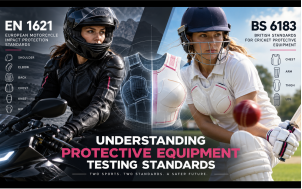
Understanding Protective Equipment Testing Standards: Is Certified Armour Really Safe?
We examine European motorcycle impact protection standards and British cricket testing standards to understand what certification means, how impact protection is measured and why meeting a standard is only part of the protection equation.
What does it really mean when protective equipment meets a safety standard?
When it comes to protective equipment, how do you know whether the armour you’re wearing actually provides the protection you expect?
We examine two recognised testing standards: European motorcycle impact protection standards (EN 1621) and British Standards for cricket protective equipment (BS 6183).
Although these standards address different sporting environments and impact hazards, they share an important purpose: establishing measurable requirements for protective equipment.
But does passing a recognised standard mean a product offers the highest possible level of protection? And can two products meeting the same standard perform differently?
The answer may surprise you.
At Fempro Armour, we believe athletes, parents and coaches deserve to understand what testing standards actually measure, what certification means and why meeting a standard is only part of the protection equation.
1. Why do protective equipment testing standards matter?
Protective equipment is designed to help reduce the severity of injuries caused by mechanical impacts.
For a motorcyclist, this might involve falling onto the road or striking a hard surface during an accident.
For a cricketer, it could mean being struck by a fast-moving cricket ball.
Although both situations involve an impact, the contact surfaces, energy transfer and potential injury mechanisms can be very different.
This is why protective equipment is assessed against standards developed for particular applications.
Depending on the standard, testing may examine:
- Impact attenuation: How effectively equipment reduces the force transmitted through it.
- Impact distribution: How impact loads are spread across the protective structure.
- Protective coverage: Whether the equipment covers the intended body region.
- Durability: How the equipment performs following specified conditioning or environmental exposure.
- Ergonomics: Whether the equipment can be worn and used appropriately.
However, not every standard measures all these characteristics in the same way.
This raises an important question: If equipment passes a laboratory test, does that mean it will provide the same protection in every real-world situation?
No.
Laboratory testing takes place under controlled conditions. Real-world impacts can involve different forces, angles, contact points and circumstances.
Testing provides a measurable benchmark, not a guarantee against injury.
2. Understanding European motorcycle armour standards
Motorcycle body armour is commonly evaluated under the European EN 1621 series of standards.
These standards establish testing requirements for impact protectors designed for different areas of the body.
| Standard | Protective equipment |
|---|---|
| EN 1621-1:2012 | Shoulder, elbow, knee, hip and other limb or joint protectors |
| EN 1621-2:2014 | Back protectors |
| EN 1621-3:2018 | Chest protectors |
| EN 1621-4:2013 | Mechanically activated inflatable protectors |
Each standard has requirements appropriate to the type of protection being assessed.
For this reason, a Level 2 chest protector should not automatically be compared with a Level 2 knee protector as though the classifications represent identical testing requirements.
What does CE Level 1 versus Level 2 actually mean?
For motorcycle limb and joint protectors assessed under EN 1621-1:2012, the test involves a controlled impact of approximately 50 joules.
The equipment is positioned on a test apparatus that measures the force transmitted through the protector during the impact.
For the mean peak transmitted force, the limits are:
Motorcycle limb protectors — EN 1621-1:2012
LEVEL 1 – 35 kN
Maximum mean peak transmitted force
LEVEL 2 – 20 kN
Maximum mean peak transmitted force
Both classifications also have individual-impact limits. Figures shown apply specifically to EN 1621-1:2012, not all motorcycle protective equipment.
Under identical laboratory conditions, lower transmitted peak force generally indicates better impact attenuation.
Can two CE Level 2 protectors perform differently?
Absolutely.
Consider two hypothetical protectors tested under the same EN 1621-1 conditions.
Example: Two protectors, one certification level
Protector A – 19 kN
Illustrative figures only; these are not actual Fempro Armour or competitor test results.
Both protectors could meet the Level 2 classification, provided they also satisfy every other applicable requirement.
Yet Protector B records approximately 42% less transmitted peak force than Protector A in this example.
This highlights an important distinction.
A certification classification identifies a performance threshold. It does not necessarily reveal the full performance of the product.
It is equally important not to confuse reduced laboratory force measurements with an equivalent reduction in injury risk. Injury outcomes depend on many additional factors.
For consumers, actual test results can provide more detailed information than a certification label alone.
3. Motorcycle chest protection: Why impact distribution matters
Chest protection introduces another important consideration.
Unlike the relatively localised structure of a knee or elbow, the chest contains the ribs, sternum and underlying organs.
Protection must consider not only the force of an impact but also how that load is managed across the protective structure.
Motorcycle chest protectors are evaluated under EN 1621-3:2018.
This standard distinguishes between impact attenuation and impact distribution.
| Testing requirement | Level 1 | Level 2 |
|---|---|---|
| Impact attenuation | Required | Required |
| Maximum mean transmitted force, attenuation | 18 kN | 18 kN |
| Impact distribution | Not required | Required |
| Maximum mean transmitted force, distribution | — | 15 kN |
The standard also specifies individual-impact limits. Level 2 chest protection requires the additional impact distribution assessment, rather than simply applying a lower attenuation threshold.
What is the difference between absorbing and distributing an impact?
Impact attenuation refers to reducing the force transmitted through a protector.
This may occur as the material compresses, deforms or dissipates energy during impact.
Impact distribution concerns how loads are spread through the protective structure rather than concentrated in a smaller area.
A protective material may perform well in attenuation testing without necessarily demonstrating the distribution performance required for Level 2 chest protection.
This is why the testing method matters.
It is also why comparing armour solely on whether it feels soft, hard, thick or flexible can be misleading.
The characteristics of a material do not, by themselves, establish its protective performance.
4. British Standards for cricket protective equipment
Cricket presents an entirely different impact environment.
A cricket ball is small, hard and capable of delivering considerable energy over a relatively concentrated area.
Unlike a motorcycle accident, where a rider may strike a broad or irregular surface, cricket body protection is intended to address hazards associated with ball impacts.
The British Standards Institution publishes the BS 6183 series covering different categories of cricket protective equipment.
Two relevant parts include:
| Standard | Purpose |
|---|---|
| BS 6183-1:2000 | General requirements for cricket protective equipment |
| BS 6183-3:2000 | Requirements and testing for leg, thigh, arm and chest protectors |
The British Standards Institution lists both as current standards.
What is BS 6183-3:2000?
BS 6183-3:2000 covers protective equipment for cricketers, including leg protectors for batters, wicketkeepers and fielders, as well as thigh, forearm, elbow and chest protectors for batters.
The standard contains specified protective zones, requirements and test procedures for these equipment categories.
The standard is relevant because cricket protection must be assessed according to the hazards of the sport.
Can motorcycle armour testing be compared directly with cricket testing?
Not directly.
Although both involve mechanical impact testing, they are not interchangeable.
Motorcycle impact protection standards and cricket protective equipment standards differ in their intended applications, testing arrangements and performance requirements.
A motorcycle protector passing EN 1621-3 does not automatically establish compliance with BS 6183-3.
Similarly, passing the British cricket standard does not establish that a product meets European motorcycle armour requirements.
This distinction is particularly important as manufacturers explore innovative materials that may be suitable for more than one sport.
A material’s performance in one application may be promising, but its suitability for another must be evaluated using appropriate evidence.
The protective material is only one part of the equation. The type of impact, product construction, fit and intended application all matter.
5. Why protective equipment should be designed around the athlete
While testing standards are essential, the way equipment fits the body is another critical consideration.
An impact protector could perform very well under laboratory conditions yet provide inadequate coverage if it is incorrectly positioned or shifts during movement.
This raises an important issue in female athlete protection.
Historically, some sporting equipment has been designed around generalised body shapes, with sizing adjustments used to accommodate different athletes.
But changing the size of a product does not necessarily address differences in anatomy.
The challenge of female chest protection
Female chest protection must account for breast anatomy, body contours and movement.
Poorly fitting equipment may create:
-
Gaps between the protector and the body.
-
Concentrated pressure or uncomfortable contact points.
-
Movement restrictions that interfere with sporting performance.
-
Shifting or displacement during activity.
-
Areas of the body that may not remain adequately covered.
A protector should be evaluated as part of a complete wearable system, not simply as an isolated piece of material.
Importantly, neither a flat nor an anatomically curved design should automatically be assumed superior without appropriate evaluation.
At Fempro Armour, our design philosophy is straightforward:
Women should not have to adapt to protective equipment that fails to consider their anatomy and how they move.
Protection should be developed around the athlete, with comfort, appropriate coverage, fit and impact performance considered together.
6. Understanding joules and kilonewtons: What do impact tests measure?
Two terms frequently appear in discussions about impact protection: joules and kilonewtons.
Although closely related to impact testing, they measure different things.
Joules (J): Impact energy
Joules measure energy.
In an impact scenario, kinetic energy depends on the mass and speed of the moving object.
The equation is: [ E=frac{1}{2}mv^2 ]
This relationship is particularly important because velocity is squared.
If the speed of an object doubles while its mass remains unchanged, its kinetic energy increases fourfold.
For cricket, this helps explain why ball speed is an important consideration when evaluating impact hazards.
Kilonewtons (kN): Transmitted force
Kilonewtons measure force.
During certain impact tests, sensors record the force transmitted through protective equipment.
The peak transmitted force is influenced by factors such as material behaviour, impact duration, geometry and the testing arrangement.
A material that deforms under impact may reduce the peak transmitted force by changing how the load develops over time.
However, a product’s thickness, weight or softness does not automatically establish its ability to attenuate impacts.
These characteristics must be evaluated through appropriate testing.
A 50-joule impact rating and a 10-kilonewton transmitted-force result are not interchangeable measurements.
Understanding both helps consumers interpret laboratory results more accurately.
7. Does thicker or harder armour provide better protection?
It is a common assumption that thicker, harder or heavier protective equipment must be safer.
But protection is not determined by thickness or stiffness alone.
Different materials manage impact energy in different ways.
Traditional protective structures may use rigid shells, foams or layered constructions.
More advanced systems may incorporate viscoelastic or rate-sensitive materials that exhibit different mechanical behaviour depending on the speed and magnitude of loading.
These technologies can offer useful design possibilities, including flexibility during normal movement and resistance or deformation under impact.
However, none of these properties alone guarantees superior protection.
The finished protector must still be assessed for the intended hazard.
For athletes, the aim is to achieve an appropriate balance between impact protection, comfort, coverage and freedom of movement.
A protector that restricts movement excessively or is uncomfortable to wear may introduce practical problems, regardless of the material’s laboratory performance.
8. Why passing a safety standard does not guarantee injury prevention
This is one of the most important distinctions athletes should understand.
Safety standards establish specific performance requirements under controlled conditions.
They do not reproduce every possible real-world accident.
For example, a motorcycle impact may involve multiple collisions, unusual impact angles or forces outside the laboratory test conditions.
Similarly, the consequences of a cricket ball impact may depend on the ball’s speed, point of contact, athlete’s posture and protective equipment positioning.
Passing a standard therefore provides evidence of performance within the specified test conditions.
It does not mean the equipment can prevent every fracture, bruise, soft-tissue injury or other form of trauma.
This does not diminish the importance of standards.
Rather, it reinforces the need to understand their purpose and limitations.
Responsible protective equipment manufacturers should communicate these limitations clearly.
9. Five questions to ask before purchasing protective equipment
Before purchasing armour for yourself, your child, a sporting club or a team, consider the following questions.
1. Which testing standard applies?
Is the product evaluated against a standard relevant to its intended use and the hazard it is designed to address?
2. What do the test results actually show?
Does the manufacturer provide measured performance information, or only a certification label?
3. Does the armour fit correctly?
Does it cover the intended region without significant gaps, uncomfortable pressure or displacement?
4. Does it work with the athlete’s movement?
Consider whether the equipment remains in position while bending, rotating, running or performing sport-specific movements.
5. What are the product’s limitations?
Understand which impacts the equipment is designed to address and which injuries it cannot guarantee against.
10. The future of athlete protection: Moving beyond minimum compliance
Testing standards are essential to the development of protective equipment.
They create consistency, establish measurable benchmarks and encourage manufacturers to demonstrate performance.
But innovation should not stop at compliance.
Advances in material science, product engineering and anatomical design create opportunities to improve protective equipment.
For female athletes in particular, there is an opportunity to rethink equipment that has not always adequately considered breast anatomy, movement or individual body shape.
At Fempro Armour, we believe the future of athlete protection should bring together three principles:
Evidence-based impact protection. Protective performance should be supported by appropriate testing and transparent technical information.
Athlete-focused design. Equipment should consider the anatomy, movement and practical needs of the person wearing it.
Continuous innovation. Manufacturers should seek to improve materials, construction, comfort and protective performance rather than treating minimum requirements as the end goal.
As new protective technologies become available, independent testing will continue to play an essential role in determining whether they deliver meaningful improvements.
Conclusion: A safety certification is the beginning, not the end
Whether you are selecting motorcycle armour or cricket protective equipment, a recognised testing standard provides an important starting point.
But understanding what that standard measures is equally important.
Two products may achieve the same classification while displaying different laboratory results.
Different sporting environments require different approaches to testing.
And effective protective equipment depends on more than materials alone.
Fit, coverage, anatomical design, correct positioning and intended use all contribute to the overall protection system.
At Fempro Armour, we believe athletes deserve to make informed decisions about the equipment they wear.
Instead of asking only, “Is this product certified?”, we should also ask:
“What was it tested for, how did it perform, and is it designed for the athlete wearing it?”
Because protection should never be based on assumptions alone.
Better protection starts with better questions.
Frequently asked questions about protective equipment testing
Is CE Level 2 motorcycle armour better than Level 1?
Level 2 represents a higher specified performance classification within the applicable EN 1621 standard. The requirements differ depending on whether the equipment protects limbs, the back or the chest.
Can two products with the same CE rating provide different levels of impact attenuation?
Yes. Two products may pass the same standard while recording different transmitted-force measurements during testing.
What British Standard applies to cricket chest and thigh protectors?
BS 6183-3:2000 covers several types of cricket body protection, including chest, thigh, arm and leg protectors for specified player roles.
Can motorcycle armour testing establish cricket protection performance?
Not automatically. Motorcycle and cricket testing standards address different impact hazards and performance criteria. Separate testing may be necessary to establish compliance with the relevant cricket standard.
Does passing an impact protection standard guarantee that injuries will be prevented?
No. Certification demonstrates performance against specified laboratory criteria. It does not guarantee that an athlete will avoid injury in every impact situation.
Why is female-specific protective equipment important?
Differences in anatomy, body shape and movement can influence the way protective equipment fits and maintains coverage. Effective product design should account for these factors alongside impact protection.