
Best Body Protection for Female Cricketers: What to Look For
A cricket ball can be delivered at considerable speed, and even when a player reacts correctly, impact with the chest, ribs or thighs can still happen. For female cricketers, choosing body protection should therefore involve more than selecting the most familiar brand, the lowest price or the product worn by a professional player.
The best cricket protection should provide meaningful impact reduction, remain securely positioned and allow the athlete to move naturally. Just as importantly, the manufacturer should be prepared to explain how the protection has been tested and what the results mean.
Cricket Body Armour Must Fit the Female Body
Much of the traditional cricket protection available today developed from equipment originally shaped around male players. Female athletes have often been expected to adapt to this equipment rather than use protection designed specifically for their bodies.
Poorly fitted body armour can create several problems. It may sit incorrectly over the chest, move during running, restrict rotation or leave areas exposed. External straps can dig into the body, while bulky pads may interfere with movement and concentration.
Protection cannot perform properly when it is not positioned over the area it is intended to protect. This makes fit and stability part of the safety equation—not simply matters of comfort.
Female-specific body armour should account for the shape of the chest and the way a female athlete moves while batting, running and fielding. It should remain close to the body without creating unnecessary pressure or restriction.
Quality Is More Than Thickness
Many people assume thicker protection must be better. That is not necessarily true.
Thickness, firmness and appearance do not prove how much impact energy a product can manage. A thick pad may feel reassuring but still transfer a significant amount of force into the body. Conversely, an advanced impact material may achieve strong performance with a lower-profile design.
Quality body armour should be assessed through a combination of factors:
- Impact performance
- Secure positioning
- Coverage of the intended body area
- Freedom of movement
- Breathability
- Durability
- Female-specific fit
- The quality and transparency of the manufacturer’s testing
Protective equipment does not make an impact disappear. Its purpose is to absorb, spread or reduce the energy that would otherwise travel into the athlete’s body.
That is why the number that matters is not only the energy applied during a test. Customers should also ask how much force passed through the armour.
Does the Brand Disclose Its Testing?
This is one of the most important questions a player, parent, coach or club can ask.
Cricket protection is frequently promoted with terms such as “advanced”, “elite”, “maximum protection”, “high impact” or “professional”. These descriptions may sound impressive, but they do not provide a measurable indication of performance.
Some established cricket brands state that their protective products undergo laboratory or wearer testing, comply with applicable regulations, or use impact-absorbing materials. However, individual product pages often do not publish details such as:
- The energy used during testing
- The type of impactor used
- The test setup and conditions
- The force transmitted through the protector
- The number of impacts performed
- A model-specific test report or certification result
This does not automatically mean the equipment is poor quality. It means the customer may not have enough information to compare one product with another properly.
A trusted brand name, a professional endorsement or a premium price is not a substitute for measurable performance data.
Customers should be able to ask: What testing was completed? At what impact energy? Under which protocol? How much force reached the body side of the armour?
If those details are unavailable, the buyer is largely relying on marketing language.
Understanding Joules and Kilonewtons
Two measurements commonly discussed in impact testing are joules and kilonewtons.
Joules measure the energy applied during the impact. A higher-joule test applies more impact energy to the protective material.
Kilonewtons, or kN, measure the force transmitted through the armour. In simple terms, this indicates how much force reaches the body side of the protector during the test.
For transmitted force, lower is generally better—but results can only be compared fairly when products are tested using the same method, energy, impactor, anvil and laboratory conditions.
A product tested at 10 joules cannot be directly compared with one tested at 50 joules simply by looking at the final transmitted-force number. The testing conditions matter.
Fempro Armour’s Approach to Cricket Protection
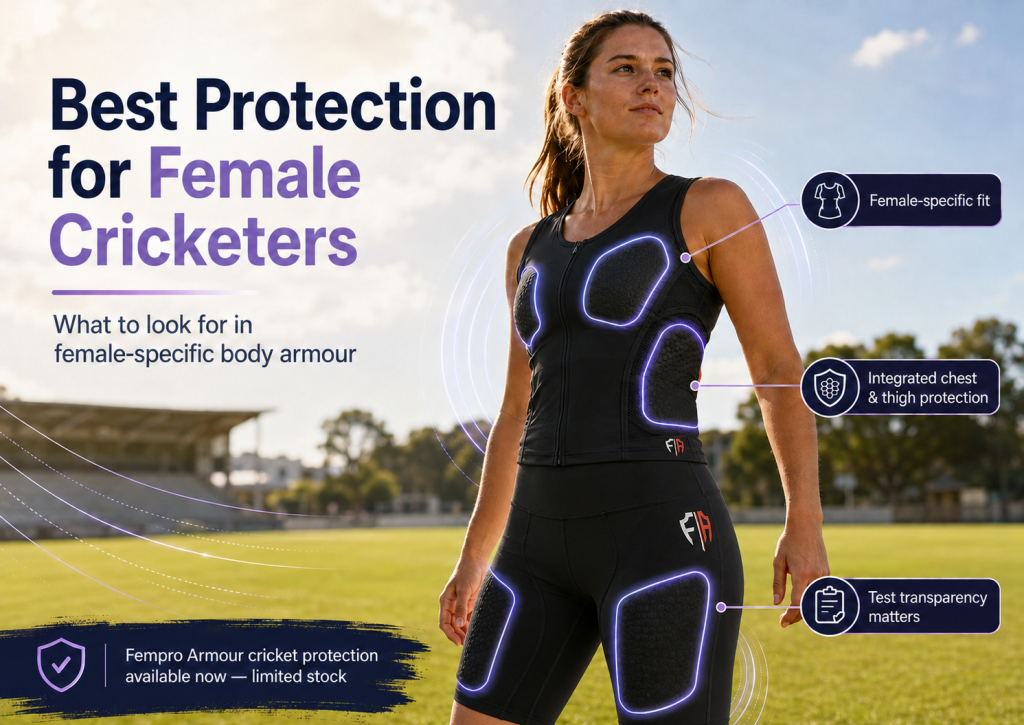
The Fempro Armour Vanguard Cricket System was developed specifically for female cricketers rather than adapting traditional male-shaped equipment.
The system integrates impact armour into fitted performance garments, helping the protection remain securely positioned while the athlete runs, bats and changes direction. Instead of relying on bulky external straps, the armour sits within dedicated pockets in the vest and pants.
The range includes:
- The Vanguard Integrated Chest Armour System
- The Vanguard Integrated Thigh Armour System
- The Vanguard Integrated Full Kit Armour System
The chest system provides female-specific chest and side coverage within a performance vest. The thigh system integrates main and inner thigh protection into fitted pants and is available for left- or right-handed batters.
At approximately 10 millimetres thick, the Vanguard armour has been designed to create a lower-profile alternative to many traditional cricket pads, which are commonly considerably thicker.
Fempro Armour’s cricket protection was independently impact-tested using a 50-joule, motorcycle-derived testing protocol. Under that test configuration, the armour transmitted approximately 15 kN.
This does not mean the product carries a motorcycle certification for cricket use, nor should the result be directly compared with products tested under different standards or conditions. The motorcycle-derived method was used to apply a defined, high-energy laboratory impact and measure how much force passed through the armour.
The important difference is transparency: the test energy, testing basis and transmitted-force result are disclosed so customers can better understand what sits behind the protection claim.
Advice for Players, Parents, Coaches and Clubs
Players should choose body armour that feels secure and does not distract them during play.
Parents should look beyond price and branding and ask what evidence supports the manufacturer’s claims.
Coaches should encourage athletes to train in their protection before match day so correct fit and positioning become familiar.
Clubs should treat female-specific protection as part of performance support, not merely an optional accessory. Equipment that stays in place and allows natural movement can help athletes play with greater confidence and less hesitation.
No body armour can guarantee that an injury will never occur. However, properly designed, correctly fitted and transparently tested protection gives players a more informed way to manage impact risk and increase performance.
The Fempro Armour Vanguard Cricket Protection range is available now in limited stock. Players, parents and clubs should secure the required size and left- or right-handed configuration before current stock is exhausted.