
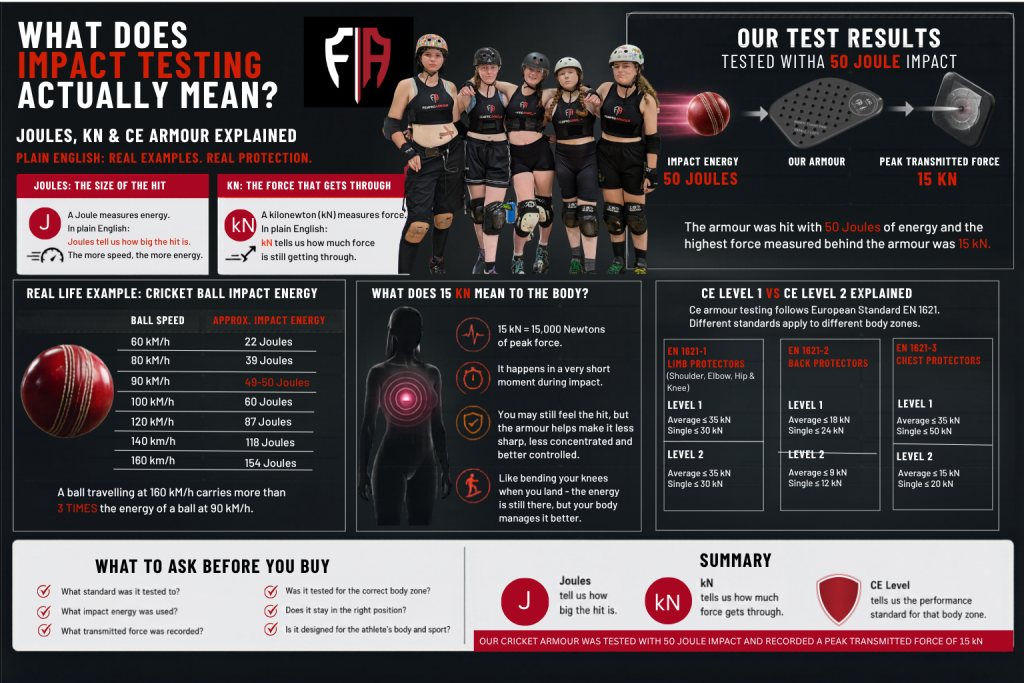
What Does 50 Joules and 15 kN Actually Mean in Protective Armour?
Most protective gear brands say their products are “tested”.
But tested how?
With what impact?
Against what standard?
And most importantly — what does that result actually mean when your body takes the hit?
At Fempro Armour, we believe athletes, riders, parents, coaches and clubs deserve to understand the gear they are trusting with their body. Protection should not be confusing. It should not be hidden behind technical language. And it should not rely on vague words like “padding”, “shock absorbing” or “protective” without explaining what those words actually mean.
That is why we want to explain impact testing in plain English.
To understand protective armour testing, there are two key terms you need to know:
Joules and kilonewtons, often written as kN.
.
What Is a Joule?
A Joule measures energy.
In impact testing, Joules tell us how much energy is delivered into the armour.
Plain English:
Joules tell us how big the hit is.
For example, if armour is tested with a 50 Joule impact, it means the armour has been struck with a controlled impact carrying 50 Joules of energy.
A good real-life comparison is a cricket ball.
A standard cricket ball weighs around 156 grams. If that ball is travelling at roughly 90 km/h, it carries close to 50 Joules of kinetic energy.
That does not mean every cricket ball impact is 50 Joules. A slower ball carries less energy. A faster ball carries much more.
Approximate examples:
| Cricket Ball Speed | Approx. Impact Energy |
|---|---|
| 60 km/h | 22 Joules |
| 80 km/h | 39 Joules |
| 90 km/h | 49–50 Joules |
| 100 km/h | 60 Joules |
| 120 km/h | 87 Joules |
| 140 km/h | 118 Joules |
| 160 km/h | 154 Joules |
This is why speed matters so much.
A cricket ball travelling at 160 km/h is not just “a bit harder” than one travelling at 90 km/h. It carries more than three times the energy.
That is why proper impact testing needs clear numbers. Without those numbers, “tested” does not tell the customer enough.
What Is kN?
A kilonewton, or kN, measures force.
In armour testing, kN tells us how much peak force is measured behind the armour after impact.
What this means:
Joules are the hit going in.
kN is the force still getting through.
This is where many customers get confused.
The armour is hit with a controlled amount of impact energy, measured in Joules. A sensor behind the armour then measures how much force is transmitted through the protector. That force is measured in kN.
So when you see a transmitted force result, that number matters.
It tells you how well the armour managed the impact.
Our Test Result Explained
Our cricket body armour for example was tested with a 50 Joule impact.
The result was:
15 kN peak transmitted force.
This means:
The armour was hit with 50 Joules of impact energy, and the highest force measured behind the armour was 15 kN.
That does not mean the impact disappeared.
No armour can make impact vanish.
But good armour is designed to absorb, slow, spread and manage the impact before it reaches the body-facing side.
The goal is to make the hit less sharp, less concentrated and better controlled.
What Does 15 kN Mean to the Body?
15 kN means 15,000 Newtons of peak force.
That sounds like a lot — and it is.
But it does not mean the athlete has 1.5 tonnes sitting on their body.
It means that during the impact, for a very short moment, the sensor behind the armour recorded a peak force spike of 15 kN.
To the body, the athlete may still feel a strong hit. Armour does not make the hit disappear. But the purpose of impact armour is to reduce how sharp and concentrated that force is.
A simple example is jumping off a step.
If you land with stiff legs, the force travels through your body quickly. It feels harsh and sharp.
If you bend your knees, the energy is still there, but your body slows the force down and spreads it over more time. The landing feels more controlled.
Good armour works in a similar way.
It gives the impact somewhere to go.
Instead of the force being concentrated into one small painful point, the armour helps spread and manage the impact.
How Does This Relate to CE Level 1 and CE Level 2 Armour?
Motorcycle riders often see armour labelled CE Level 1 or CE Level 2.
These levels come from recognised European motorcycle protection standards, commonly within the EN 1621 family of standards.
Different standards apply to different parts of the body:
| Standard | Used For |
|---|---|
| EN 1621-1 | Limb protectors such as shoulders, elbows, hips and knees |
| EN 1621-2 | Back protectors |
| EN 1621-3 | Chest protectors |
The simple explanation is this:
CE testing measures how much force is transmitted through the armour after a controlled impact.
In general, CE Level 2 allows less force through than CE Level 1, which means Level 2 usually represents higher impact performance.
But there is an important point: the exact kN limits depend on the body zone and the specific EN 1621 standard.
So “CE tested” by itself is not enough information.
A better question is:
What standard was it tested to?
What body zone was it tested for?
What impact energy was used?
What transmitted force was recorded?
Was it Level 1 or Level 2?
Those are the questions customers should be asking.
Why Lower kN Matters
Lower kN means less peak force was measured behind the armour during the test.
That is important because the body does not care how protective something looks.
The body feels what gets through.
A product can look thick and still perform poorly.
A product can feel hard and still transfer a sharp force spike.
A soft foam can feel comfortable but collapse too quickly under impact.
That is why impact testing is so important. It gives customers a way to understand how armour performs under controlled conditions.
Not just how it looks.
Not just how it feels in your hand.
But how it manages impact when it is hit.
Why This Matters for Female Athletes
For too long, protective gear has been designed around male body shapes and then resized for women.
That is not good enough.
Female athletes need protection that considers female anatomy, movement, comfort and real impact zones.
In cricket, rugby, AFL, NRL, motorcycle riding and other impact environments, women are exposed to serious localised impacts. Yet many products are still bulky, uncomfortable, poorly positioned or not properly explained.
At Fempro Armour, we believe protection should be designed for the body that actually wears it.
That means the right fit.
The right placement.
The right materials.
And clear information about what has been tested.
Because confidence does not come from guessing.
It comes from understanding.
What Customers Should Look For Before Buying Protective Gear
Before buying protective armour, ask these questions:
1. Has the product been impact tested?
Not just “tested” in vague language. What was actually tested?
2. What impact energy was used?
Was it tested at 50 Joules? Higher? Lower?
3. What was the transmitted force result?
How much force passed through the armour?
4. What standard was used?
For motorcycle armour, was it tested under the relevant EN 1621 standard?
5. Does the armour stay in the right position?
Protection only works properly if it protects the right area during movement.
6. Is it designed for the athlete’s body and sport?
Fit and placement matter just as much as material performance.
If a brand cannot explain these things clearly, that is a problem.
The Simple Summary
A Joule tells us how big the hit is.
A kN tells us how much force gets through.
A CE Level tells us whether armour meets a recognised performance threshold for a specific body zone.
Our armour was tested with a 50 Joule impact and recorded a peak transmitted force of 15 kN.
That means the armour helped absorb, slow, spread and manage the impact before it reached the body-facing side.
The impact does not disappear.
But properly designed armour can make the hit less sharp, less concentrated and better controlled.
And that is what real protection should be about.
Not guesswork.
Not bulky padding.
Not marketing words.
Protection should be tested, explained and understood.
Because when your body takes the hit, what matters is not what the gear claims.
What matters is what gets through.