WHAT WE TESTED
A CONTROLLED APPROACH TO IMPACT.



Exploring how high-g sensors can detect and localise torso impacts in contact sport.
In collaboration with Griffith University, we investigated whether a compact sensor system could capture short-duration, high-g impacts across body armour and identify where those impacts occurred.
VIEW FULL PAPER
Sensors designed to capture short-duration, high-acceleration events.
Controlled laboratory impacts applied across the armour surface.
Used to identify impact location and create visual heatmaps.
The study used four accelerometer nodes across six torso regions and interpolation to estimate adjacent areas.
This research does not prove that armour reduces injury. What it does provide is a technical foundation for future wearable impact monitoring.
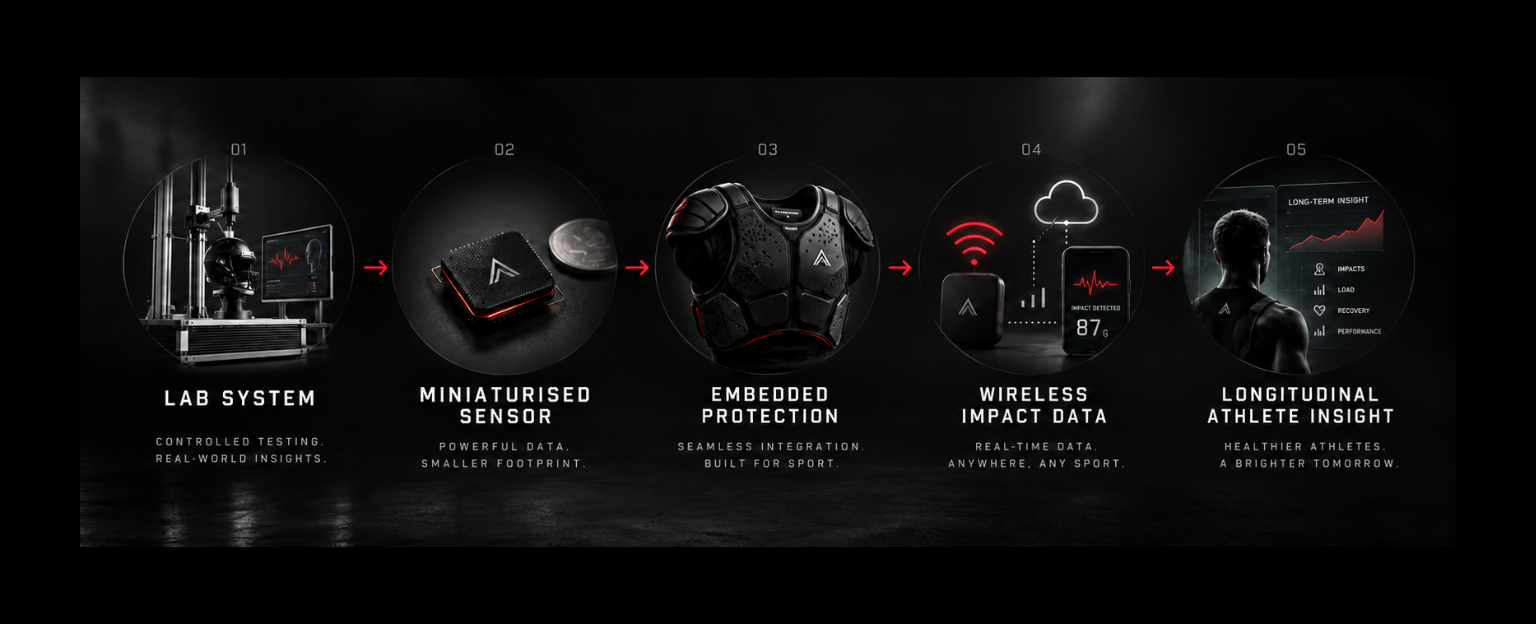
The next opportunity is to miniaturise the system, integrate it into protective equipment and develop wireless technology capable of collecting impact data in real sporting enviroments.
Read the full research paper:
“IMU_Based Impact Characterisation of Body Armour for Use in Contact Sports.
In collaboration with Griffith University & Australian Armour Company t/s as fempro Armour, this study explores high-g impact sensing and localisation across the torso.
READ THE FULL PAPERWe are looing for clubs, sporting organisation, universities, researchers and technology partners to help take impact research from lab to real-world sport.
connect with us